






How to Support Your Partner's Mental Health After Having a Baby


The weeks after a baby arrives are supposed to be joyful. And they are, in many ways. But they're also exhausting, disorienting, and for a lot of new parents, genuinely hard on mental health.
1 in 5 women experience a perinatal mental health complication during pregnancy or the postpartum period. That statistic is well-documented. What gets far less attention is what happens to the partner standing beside her: research shows that up to 50% of partners of women with postpartum mental illness experience severe psychological distress themselves, and studies consistently find that most partners receive little to no guidance on how to help.
The real gap is not awareness. It's an action. Most partners want to help. They just don't know how, and the healthcare system rarely tells them.
This guide is for both of you – whether you're the one navigating the emotional weight of new motherhood, or the one trying to show up for her.
- What Your Partner Is Actually Going Through
- How to Actually Show Up
- Warning Signs to Watch For
- Getting Her Professional Help
- Your Mental Health Matters Too
- Resentment, Disconnection, and Intimacy
- Building a Postpartum Wellness Plan Together
- FAQ: How to Support Your Partner's Mental Health After Having a Baby
What Your Partner Is Actually Going Through
Before you can support someone, you need to understand what you're dealing with. Postpartum mental health is not one thing. It exists on a spectrum, and the label matters less than recognizing the signs.
Baby Blues vs. Something More Serious
Most new mothers experience the baby blues in the first one to two weeks after birth – tearfulness, mood swings, irritability, and emotional fragility. This is normal, driven by the enormous hormonal shift that follows delivery, and it typically resolves on its own.
What's not normal, and shouldn't be waited out, is when those feelings persist, intensify, or take on a different character entirely.
| Condition | When It Appears | What It Looks Like |
|---|---|---|
| Baby Blues | Days 2–5 post-birth | Tearfulness, mood swings – resolves within 2 weeks |
| Postpartum Depression | Within 6 weeks (can emerge up to 1 year) | Persistent sadness, withdrawal, feelings of failure, difficulty bonding |
| Postpartum Anxiety | Anytime in the first year | Constant worry, physical tension, inability to rest, intrusive thoughts |
| Postpartum PTSD | After a traumatic birth | Flashbacks, hypervigilance, and avoidance of anything that recalls the birth |
| Postpartum Psychosis | Within the first 2 weeks | Confusion, hallucinations, rapid mood shifts – a medical emergency |
According to research published in PMC, postnatal depression affects between 6.5% and 20% of postpartum women, while postpartum anxiety is even more common, affecting up to 27.9% of new mothers. Postpartum PTSD affects between 4.6% and 16.8% of women, rising as high as 30% after emergency surgical deliveries.
Why She May Not Say Anything
Here's something partners often don't realize: most women with postpartum mental health struggles go undiagnosed and don't seek help. The reasons stack on top of each other – shame, the expectation that motherhood should feel joyful, fear of being seen as an unfit mother, exhaustion that makes asking for help feel impossible, and often, not recognizing their own symptoms as anything other than "just being a new mum."
This is exactly why your role matters. You're in a position to notice what she may be minimizing or can't see in herself.
How to Actually Show Up
There's a difference between being present and being supportive. A lot of partners are physically there but emotionally unavailable, or willing to help but waiting to be asked. Both patterns leave new mothers unsupported.
The research is clear: partner support is the single strongest protective factor for postpartum mental health – stronger even than broader social support networks. What you do day-to-day matters more than any single grand gesture.
Listen Without Trying to Fix
When she says, "I feel like I'm failing at this," the instinct for most partners is to immediately reassure or problem-solve. "You're doing great" or "What do you need me to do?" Both feel helpful. Both can land as dismissive.
What she often needs first is to feel genuinely heard.
Try this instead: put down your phone, make eye contact, and say something like "That sounds really hard. Tell me more about how it's been feeling that way." The goal is connection, not a solution. You can problem-solve later. Listening has to come first.
Take Over Without Being Asked
One of the most consistent findings in postpartum research is that new mothers carry a disproportionate share of invisible labor – the mental load of anticipating every need, tracking feeding schedules, managing visitors, worrying about what comes next. Being asked to delegate that is itself exhausting.
The most effective support is proactive, not reactive.
Some of the highest-impact things: take the baby for a two-hour stretch each morning so she can sleep uninterrupted. Handle one full feeding overnight if she's not exclusively breastfeeding. Cook or order dinner without asking what she wants. Manage all visitor communication and set limits on her behalf. Take over a full day of baby care on weekends.
67% of couples report a significant drop in relationship satisfaction in the first three years after having a baby. A lot of that friction comes from unequal labor distribution. Closing that gap isn't just supportive – it's protective for the relationship.
Acknowledge the Invisible Work
New mothers, especially those struggling with postpartum depression, frequently feel like their efforts go unnoticed. When the work you're doing is invisible by nature – keeping a baby alive, running a household, operating on no sleep – it's easy for it to feel meaningless without someone naming it.
Say it out loud: "I see how hard you're working. What you're doing for this family is extraordinary."
Ten seconds. It matters more than you might expect.
Warning Signs to Watch For
Partners are often the first to notice something has shifted – sometimes before the new mother recognizes it herself. Knowing what to look for isn't about diagnosing. It's about knowing when to gently step in.
Watch for any of the following that last more than two weeks, worsen over time, or get in the way of daily life:
- Persistent sadness, tearfulness, or emotional numbness
- Withdrawal from the baby, from you, or from things she used to enjoy
- Saying she feels like a bad mother, worthless, or a burden
- Difficulty sleeping even when the baby is asleep
- Appetite changes – eating very little or significantly more than usual
- Intense, uncontrollable worry about the baby's safety
- Irritability or anger that feels out of character
- Intrusive thoughts, she seems ashamed to share
If she mentions any thoughts of harming herself or the baby, treat this as a medical emergency. Contact her healthcare provider immediately or go to the nearest emergency room.
How to Raise It Without Making Things Worse
Timing and framing matter a lot here. Don't bring it up when either of you is exhausted, in the middle of a feed, or already in conflict. Find a quiet moment and lead with care.
Something like: "I've noticed you seem really overwhelmed lately, and I'm worried about you. Not about anything you've done wrong – I just want to make sure you're okay. Can we talk about how you're actually feeling?"
What not to say: "You've been so negative lately" or "I think you have postpartum depression." Labels can feel like accusations. Your job is to open the door, not diagnose.
Getting Her Professional Help
One of the most concrete things a partner can do is remove the barriers to professional support. Most women with postpartum mental health struggles don't seek treatment – not because they don't want to feel better, but because the practical barriers are enormous. Who watches the baby? How do I find someone? What do I even say? Will it mean something is really wrong with me?
You can solve most of those barriers directly.
Research options together and do the legwork so she doesn't have to. Offer to make the call. Take the baby to every appointment so she can attend without guilt. Go with her if she'd find that easier. After appointments, ask how she's feeling about it – not whether it helped.
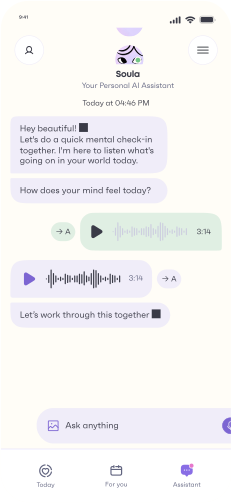
For between-session support, Soula Care offers 24/7 AI-powered emotional support designed specifically for women navigating pregnancy, postpartum, and hormonal health. Having something available at 3 am when the anxiety peaks and no therapist is reachable makes a real difference.
Postpartum mental health treatment works. Cognitive behavioural therapy and interpersonal therapy are both well-supported for postpartum depression and anxiety. Antidepressants are safe for many breastfeeding mothers. Peer support groups have documented benefits for both mood and isolation. And research consistently shows that women who receive partner support alongside professional treatment have significantly better outcomes than those who receive treatment alone.
Your Mental Health Matters Too
This part is for the partner. Not as an afterthought – as something that genuinely matters, and that directly affects how well you can show up for her.
Research published in PMC found that 50% of partners of women with postpartum psychiatric illness experienced severe psychological distress in the first month. 40% reported poor coping. Most received no support or guidance of their own.
Paternal postpartum depression is real. Studies estimate that between 8% and 13% of new fathers experience depression after a baby is born, with rates rising when their partner is also struggling.
Signs that you might be struggling: persistent irritability that feels out of proportion; withdrawing from your partner, the baby, or other people; increased use of alcohol; feeling trapped, resentful, or like you've lost yourself; difficulty functioning at work; feeling like you can't talk to anyone about what you're experiencing.
You can't pour from an empty cup. Talking to someone – a friend, a therapist, a support group – isn't a luxury. It's what makes sustained support possible. Maintain at least one outlet that's genuinely yours: 30 minutes of exercise, time outside, something that's not about the baby. Be honest with your partner. Saying "I'm finding this hard too" can deepen the connection rather than add burden.
The transition to parenthood is one of the most significant identity shifts a person can go through. You are allowed to find it hard.
Resentment, Disconnection, and Intimacy
There are two postpartum experiences that rarely get named directly, even though they're nearly universal: rage and a profound shift in intimacy. Both can feel shameful. Neither is a sign that the relationship is broken.
Why Rage Happens, and What It's Telling You
If you're a new mother who's found yourself furious at your partner for sleeping through a feed, for leaving dishes in the sink, for simply existing without the weight you're carrying – you're not alone, and you're not a bad person.
Research published in PMC found that postpartum rage is almost always rooted in violated expectations and unmet needs. When a mother expects parenting to be a shared undertaking and finds herself carrying the majority of the physical and mental load, resentment is the predictable result. The anger isn't irrational. It's information.
Postpartum rage is a sign that a mother is overburdened and undersupported. It's not a character flaw, not something to suppress, and not something a partner should take personally without also asking: what is she carrying that I'm not seeing?
For partners: if she's angry, resist the instinct to defend yourself. Ask instead: "What do you need from me that you're not getting?" The answer will tell you more than any argument.
For mothers: if you're feeling resentment or disconnection toward your partner and don't yet have the words, Soula Care offers a private, judgment-free space to work through those emotions before you're ready to say them out loud.
Intimacy After Birth
Intimacy changes after a baby aren't a relationship problem. They're a physiological, psychological, and logistical reality that affects nearly every new parent.
For the birthing parent, low estrogen during breastfeeding, physical recovery, body image shifts, and the relentless demands of newborn care all affect desire and comfort with physical closeness. It's not rejection. It's biology compounded by exhaustion.
For the partner: feeling pushed away, or as the relationship has fundamentally changed, is common and valid. So it is not knowing how to raise it without making things worse.
A few things that help: choose a moment when neither of you is feeding the baby, exhausted, or already in conflict. Lead with curiosity, not need – "I've been missing feeling close to you. Can we talk about how you're feeling about that side of things?" Make it safe to say "not yet": "I'm not asking for anything to change right now. I just want to understand where you are." Agree on small forms of non-sexual physical connection in the meantime – holding hands, a longer hug, sitting close.
Reconnecting after a major physical experience takes patience and honest conversation. What felt natural before may need to be renegotiated. That's not failure. It's an adaptation.
If you're struggling to find the words, Soula can help you work through what you want to say before you say it – guided prompts, daily emotional check-ins, and a private space to untangle your own feelings first.
Building a Postpartum Wellness Plan Together
One of the most underused tools new parents have is a simple postpartum wellness plan – a written agreement, made before or shortly after birth, about how you'll both handle the emotional, physical, and logistical demands of this period. Think of it as a birth plan for your mental health.
It doesn't need to be formal. A shared note on your phone works. What matters is that you've had the conversation and written down what you agreed.
Physical support: Who takes which overnight feeding shifts? What does she need to protect her sleep? Who manages meals for the first few weeks?
Emotional support: How does she prefer to be comforted when she's struggling? (Some people want to talk. Others want a quiet presence.) What's the signal that means "I need you to just listen right now"? How will you check in beyond "how's the baby?"
Boundaries and visitors: Who manages visitor requests? How long do people stay? Who's allowed to come over without her needing to perform?
Help thresholds: At what point will you both agree to seek professional support? Who makes the call if one of you notices the other isn't coping?
Having this conversation before you're in the middle of it removes the friction of making decisions while exhausted and overwhelmed. It also signals something important: that you're in this together, and that her mental health is something you're actively planning for – not just reacting to when things get bad.
Postpartum mental health struggles are not a sign of weakness or failure. They're a predictable, documented response to one of the most demanding transitions in human life. The difference between families that come through it stronger and those that fracture is almost always the quality of the support system – and that starts with the person closest to her.
FAQ: How to Support Your Partner's Mental Health After Having a Baby
Why do I feel rage and resentment toward my partner after the baby?
Postpartum rage and resentment are extremely common, and they're almost always rooted in a gap between expectations and reality. Research from PMC identifies the core trigger as violated expectations, when a mother anticipated shared parenting and instead finds herself carrying a disproportionate physical and emotional load, anger is the natural result. Hormonal shifts, sleep deprivation, and loss of personal autonomy compound it further. It's a signal that your needs aren't being met and something in the dynamic needs to change.
Can Soula help me process resentment or disconnection in my relationship after birth?
Yes. Soula offers a private, judgment-free space to work through difficult emotions, including resentment, disconnection, and the grief that can come with how a relationship changes after having a baby. The support is available 24/7, which matters because these feelings tend to surface at 3 am, not during office hours. It's not a replacement for couples therapy, but it's a real starting point for understanding your own emotional experience before bringing it to your partner or a professional.
Can Soula help me talk to my partner about intimacy changes?
It can help you clarify your own feelings and find language for experiences that are hard to articulate. Many people find it easier to work out what they want to say privately before having a vulnerable conversation with their partner. Soula Care offers guided emotional check-ins and reflective prompts that help you identify what you actually need – which is often the hardest part of starting these conversations.
How do I reconnect with my partner after a difficult birth or physical recovery?
Slowly, and with explicit communication. Start with a low-pressure physical connection – sitting together, a longer hug, hand-holding. Name what you're experiencing without making it your partner's problem to fix: "My body still feels unfamiliar to me, and I'm working through that." Give each other permission to go slowly. If the disconnection feels persistent or painful for either of you, a perinatal-informed couples therapist can help. Soula Care can support the internal work that makes those conversations possible.
How do I have honest conversations about intimacy after everything has changed?
Timing and framing are everything. Choose a moment outside of conflict, exhaustion, or feeding. Lead with curiosity rather than complaint: "I've been thinking about us, and I want to understand how you're feeling too." Be honest with yourself first – it makes it safer for her to be honest back. Avoid framing intimacy changes as something one person caused. They're a shared experience that needs a shared response. If you're not sure where to start, working through your own feelings first – with Soula or a therapist – often makes the conversation with your partner significantly easier.
cope with any stress
Don't postpone self-care!
Download the app now!








and inner peace in all areas of your life,
regardless of your age